 VEX Tutorials
Mix n Match Game Breakdown
What you'll learn
- Understand the Mix n Match field layout and game objects
- Know how Pins, Beams, and Stacks score points
- Identify key autonomous objectives
- Understand basic match strategy
Welcome to Mix n Match
Mix n Match is the 2025-2026 VEX IQ Robotics Competition challenge. The core objective is simple to describe but tricky to master: stack Pins and Beams together, then place those stacks into Goals to maximize your score.
Understanding the game is the first step to building a great autonomous routine. You cannot program your robot to score if you do not know how scoring works.
Let us break it all down.
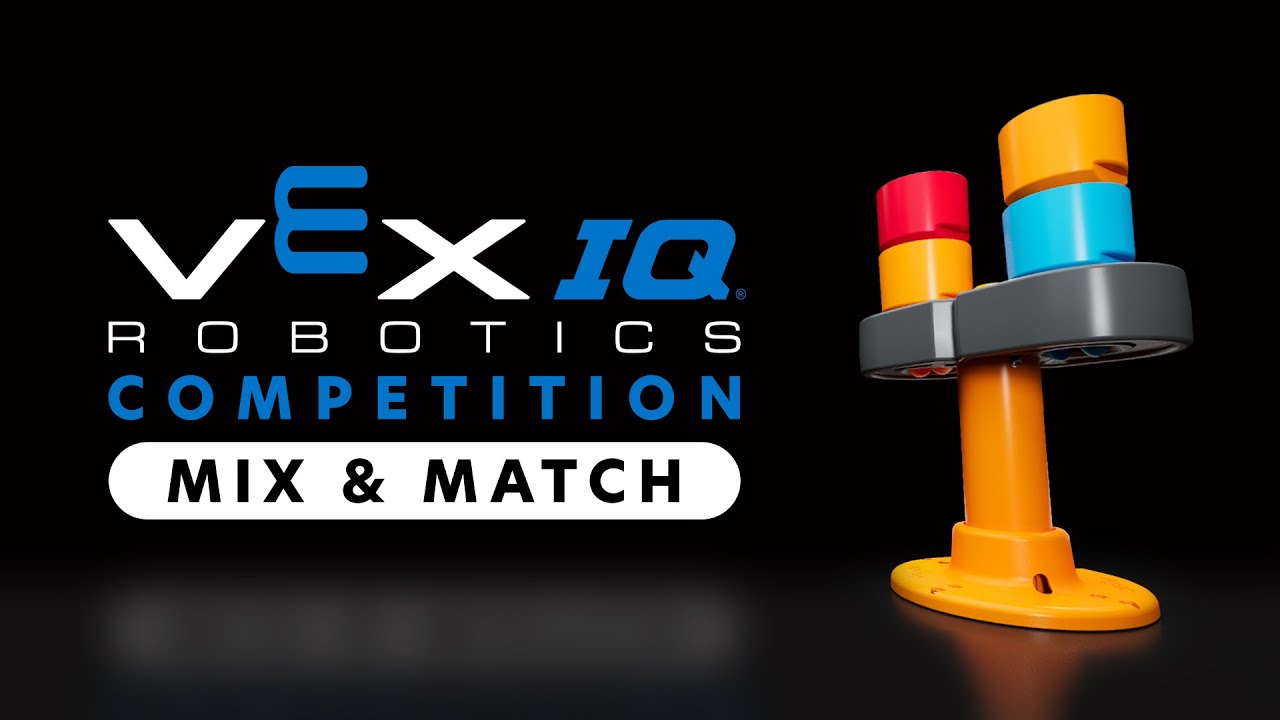
Mix n Match Game Overview
Important: Always check the official VEX IQ Game Manual for the complete and current rules. The details below are meant to help you understand the general structure, but the official manual is the final authority.
How a Match Works
Teamwork Challenge
Two teams form an alliance and work together on the 6’ x 8’ field. Each team has two drivers and one loader:
- Driver 1 operates the robot for the first half of the match.
- Driver 2 takes over for the second half.
- The loader feeds Pins into the Load Zones for the full 60 seconds.
The match lasts 60 seconds total. There is no separate autonomous period in Teamwork — it is all driver controlled.
Robot Skills Challenge
This is where autonomous programming shines. Teams compete in two types of Skills matches:
- Driving Skills — fully driver controlled, 60 seconds
- Autonomous Coding Skills — fully autonomous with limited human interaction, 60 seconds
The scores from both are combined for the Robot Skills Champion ranking. A strong autonomous Skills run can make a massive difference in your overall Skills ranking.
The Game Objects
Pins
Pins are the primary game object. They are 116mm tall and 80mm in diameter — think of a short, wide cylinder. There are three colors:
- 10 Red Pins (1 preload, 6 delivered by loader, 3 pre-placed on field)
- 10 Blue Pins (same distribution as Red)
- 16 Orange Pins (all pre-placed on the field)
That is 36 Pins total on the field.
Beams
Beams are the key to high scores. They are 251mm long, 124mm wide, and 50mm tall — flat, rectangular pieces. Beams are not color-specific and act as wild cards in stacking. There are 2 Gray Beams that start fixed on the field.
Stacking
The entire game revolves around stacking. You place Pins and Beams on top of each other to create Stacks, then place those Stacks in Goals. The taller and more colorful your stacks, the more points they are worth.
Critical rule: A single game object sitting alone is worth zero points. Objects must be connected in a stack of two or more to score. This means just pushing Pins around does nothing — you need to actually build stacks.
Field Layout
The field is a 6-foot by 8-foot rectangular playing area with several types of Goals:
Goals
| Goal | Color | Capacity | Location |
|---|---|---|---|
| Red Square Goal | Red | 1 stack | Near red side |
| Blue Square Goal | Blue | 1 stack | Near blue side |
| Red Triangle Goal | Red | 3 stacks | Red side |
| Blue Triangle Goal | Blue | 3 stacks | Blue side |
| Floor Goal | Neutral | 4 stacks | Center of field |
| Standoff Goal | Neutral | Special | Elevated, center |
Load Zones
There are colored Load Zones on each side of the field where loaders place Pins for the robot to pick up. Only one Scoring Object can be in the Loading Zone at a time, and the robot cannot touch an object while it is being placed.
Starting Positions
Each robot has a designated starting area. For autonomous Skills, your routine must begin from this position.
Scoring Breakdown
Here is where Mix n Match gets interesting. Scoring is not just about quantity — it is about how you build your stacks.
Base Points
| Object in a Stack | Points |
|---|---|
| Each Pin (when part of a stack) | 1 point |
| Each Beam (when part of a stack) | 10 points |
| Single object (not in a stack) | 0 points |
Color Bonus
Stacks earn bonus points based on how many different colors of Pins are included:
| Colors in Stack | Bonus |
|---|---|
| 1 color | 0 bonus |
| 2 colors | +5 points |
| 3 colors (Red + Blue + Orange) | +15 points |
Beam Bonus
If a stack includes a Beam, it earns an additional +10 point bonus on top of the Beam’s base 10 points.
Standoff Goal Bonus
Any stack placed on the elevated Standoff Goal earns an extra +10 points.
Scoring Example
Let us walk through a high-value stack:
A 3-color stack with a Beam placed on the Standoff Goal:
- 3 Pins (Red + Blue + Orange) = 3 points
- 1 Beam = 10 points
- 3-color bonus = +15 points
- Beam bonus = +10 points
- Standoff Goal bonus = +10 points
- Total = 48 points from a single stack
Compare that to pushing three loose Pins into a corner: 0 points. Stacking is everything.
What This Means for Strategy
The scoring system heavily rewards multi-color stacks with Beams. A single well-built 3-color stack with a Beam is worth more than a dozen loose Pins. This has huge implications for autonomous:
- Even scoring one good stack during autonomous is extremely valuable
- Grabbing and stacking a Beam should be a high priority
- Orange Pins are pre-placed on the field and available from the start — they are your easiest pickup
Autonomous Strategy
For Autonomous Coding Skills, your robot gets 60 seconds to score entirely on its own. Here is how to approach it.
The Golden Rule: Consistency is King
A simple autonomous that works every single time will beat a complex one that fails half the time.
At competition, you get limited Skills attempts. If your autonomous works 100% of the time and scores a solid stack each run, that is reliable points. If you have a fancy routine that sometimes scores 80 points but sometimes scores 0, you are gambling.
Consistency wins tournaments.
Start Simple, Build Up
Simple (Week 1-2):
- Pick up one Orange Pin and one nearby Pin of another color
- Stack them together and place in the nearest Goal
- This alone could score 7+ points (2 Pins + 5-point color bonus)
Medium (Week 3-4):
- Build a 2-3 Pin stack with multiple colors
- Include a Beam in the stack for +20 points (10 base + 10 bonus)
- Place the stack in a colored Goal that matches
Advanced (Week 5+):
- Multi-stack routines hitting multiple Goals
- Grab Beams early for maximum point multipliers
- Target the Standoff Goal for the +10 bonus
- Use sensor feedback for precise stacking alignment
Key Autonomous Priorities
- Grab a Beam early — Beams are worth 20 points in a stack (10 base + 10 bonus). There are only 2 on the field.
- Collect different colored Pins — The 3-color bonus (+15) is massive.
- Target the Standoff Goal — If you can reliably place a stack there, the +10 bonus adds up fast.
- Use the Orange Pins — They are pre-placed on the field and do not require a loader. Perfect for autonomous.
- Stack, do not scatter — Loose objects score zero. Always build stacks.
A Story From Competition
At an early Mix n Match event, one team had an autonomous that simply drove forward, picked up two Orange Pins, stacked them, and placed the stack in the Floor Goal. Total: 2 points. Not impressive, right?
But they did it every single time. Meanwhile, teams with more ambitious routines were dropping Pins, failing to align with Goals, or knocking over their own stacks. A reliable 2 points per run, combined with strong driver control, was enough to keep them competitive.
By their third tournament, that same team had refined their routine to build a 3-color stack with a Beam and place it in the Floor Goal. That is 38 points from autonomous alone. They built up to it one step at a time.
Start simple. Get consistent. Then add complexity.
Tips for Success
Build a Reliable Stacking Mechanism
Your robot needs to be able to pick up, stack, and place objects accurately. A wobbly intake or an unreliable lift will make autonomous programming much harder. Get the hardware right first.
Practice on a Full-Size Field
Autonomous routines are very sensitive to distances and Pin positions. If you do not have a field, measure out the 6’ x 8’ dimensions and use tape to mark Goal positions. Place Pins in their actual starting locations.
Test With Real Game Objects
Pins and Beams have specific weights and friction properties. Using stand-in objects for practice will throw off your calibration. Use real game objects whenever possible.
Coordinate With Your Alliance Partner
In Teamwork matches (if your alliance chooses to run autonomous at the start), make sure your robots are not fighting over the same Pins or Goals. Talk to your partner before the match.
Keep Your Code Organized
Organizing your code into separate functions for each action makes it easy to test each piece individually and swap between simple and complex routines at competition.